Monday, June 23, 2025

Drought, Conflict, and Inflation: The Perfect Storm for Global Food Prices

The world’s food supply is facing a dangerous combination of threats: war, inflation, and increasingly, drought. Across continents, dry conditions are pushing up prices on everything from coffee to beef.

In Brazil, severe drought has damaged coffee crops and driven global prices higher. The Midwestern United States has experienced years of poor rainfall, forcing ranchers to reduce cattle herds and causing beef prices to reach record levels. In China’s Yellow River Basin, which is one of its key wheat-producing regions, hot and dry weather is threatening harvests. Even Europe is feeling the strain, as drought threatens agriculture in Southern Europe and puts additional pressure on the Mediterranean diet.

The increasing concentration of food production adds to the vulnerability. Brazil and Vietnam supply most of the world’s coffee. Although wheat production is more widely distributed, major producers like Russia and Ukraine are both facing drought while also dealing with war. This combination is tightening global wheat supplies.

Climate change is intensifying drought patterns, leading to more frequent and severe disruptions in agriculture. Since much of the world’s calories come from just three staple grains—rice, wheat, and corn—any regional weather shocks can have global consequences.

As Somini Sengupta reports, drought is no longer a local problem. It has become a global risk to food security. Building resilience in food systems through diversified sourcing, sustainable water management, and stronger climate adaptation efforts is becoming increasingly urgent.

NYTimes

Thursday, June 19, 2025

Impacts of climate change on global agriculture accounting for adaptation


Climate change threatens global food production, but there’s uncertainty about how much adaptation can mitigate these impacts. Even in well-studied systems like U.S. agriculture, some analyses suggest that adaptation will be widespread and minimize damages, while others predict limited adaptation and significant losses. Global scenario models indicate adaptation could meaningfully affect productivity, but empirical data on the extent of real-world adaptation at a global scale have been lacking.


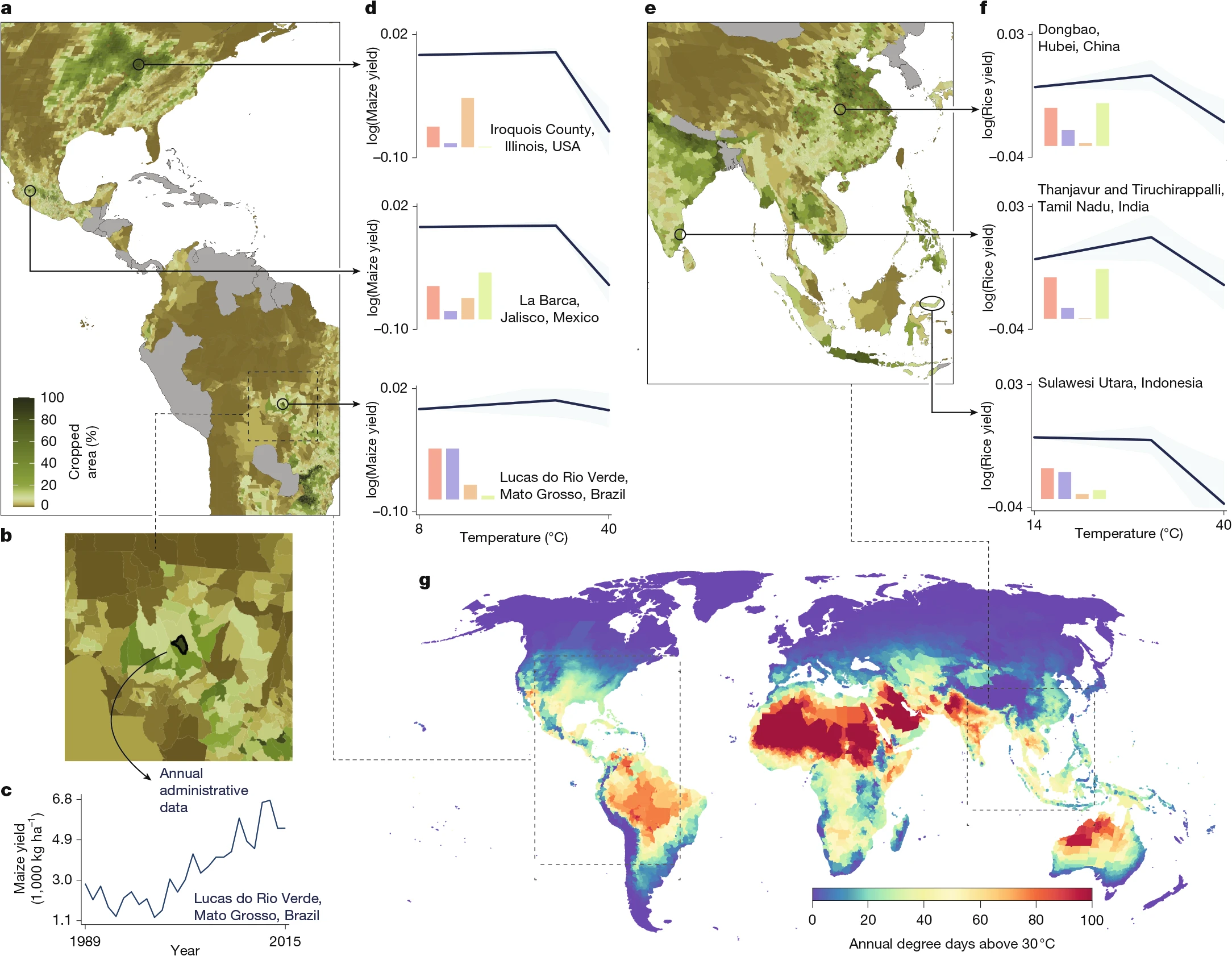
This study uses longitudinal data on six major staple crops across 12,658 regions—covering about two-thirds of global crop calories—to empirically estimate adaptation effects. We find that global production declines by approximately 5.5 × 10¹⁴ kcal per year for each 1°C increase in global mean surface temperature (equivalent to 120 kcal per person per day, or 4.4% of recommended daily intake; P < 0.001).

Projections suggest that adaptation combined with income growth could offset 23% of potential losses by 2050 and 34% by 2100 under a moderate emissions pathway, though substantial losses persist for most crops aside from rice. Interestingly, while many studies emphasize disproportionate harm to low-income regions, our results indicate that significant impacts will also occur in current major production zones—‘breadbaskets’ with relatively favorable climates that have not yet required extensive adaptation. Low-income regions still face significant losses as well. The findings highlight the scale of innovation, land-use change, or additional adaptation measures that may be necessary to secure global food supplies under climate change.

Citation

Hultgren, A., Carleton, T., Delgado, M., Gergel, D. R., Greenstone, M., Houser, T., Hsiang, S., Jina, A., Kopp, R. E., Malevich, S. B., McCusker, K. E., Mayer, T., Nath, I., Rising, J., Rode, A., & Yuan, J. (2025). Impacts of climate change on global agriculture accounting for adaptation. Nature, 642, 644–652. https://doi.org/10.1038/s41586-025-09085-w:contentReference[oaicite:0]{index=0}


Saturday, March 8, 2025

Summary: Climate change, hurricanes, and sovereign debt in the Caribbean basin

Climate change, hurricanes, and sovereign debt in the Caribbean basin


Eduardo Cavallo, Santiago Gomez, Ilan Noy & Eric Strobl (07 Mar 2025): Climate change, hurricanes, and sovereign debt in the Caribbean basin, Climate and Development, DOI: 10.1080/17565529.2025.2475148


To link to this article: https://doi.org/10.1080/17565529.2025.2475148 (open access)


This research explores the relationship between climate change, hurricanes, and government debt in the Caribbean region. Caribbean countries frequently experience severe hurricanes, which scientists expect will worsen due to human-caused climate change. Because these nations already face high levels of debt, understanding the economic impact of these disasters is crucial.

The study analyzed data from hurricanes occurring between 1970 and 2020, assessing their effect on public debt. Researchers found that hurricanes significantly increase debt levels, as governments must borrow more to fund recovery and reconstruction efforts. Specifically, after the ten most intense hurricanes, countries' debt increased nearly 10% more than it would have without the storm. Three years after such hurricanes, debt levels were almost 18% higher compared to predicted debt without the hurricane.

Scientists attribute part of these impacts to human-caused climate change, particularly through increased rainfall intensity during hurricanes. Current climate change has likely led to at least a 10% increase in rainfall during these storms. This additional rainfall linked to climate change translates to about a 3.8% rise in debt levels following major hurricanes.

These findings underline the financial vulnerability of Caribbean countries to climate change, highlighting the need for international policies and financial support mechanisms to assist these nations in managing climate-related disasters.

Wednesday, February 12, 2025

Building for a Hotter Future: Smart Design Solutions to Cut Building Energy Use, Particularly in the Global South

Buildings in hot climate zones face unique challenges in reducing energy use and CO₂ emissions, especially as urbanization and population growth drive new construction. This study examines how different design choices and technologies can help make buildings more energy-efficient while keeping them comfortable in high temperatures. Using computer simulations, the researchers tested five building types—ranging from homes to offices—across five hot climate regions. They explored a mix of passive design strategies (like better windows, reflective roofs, and solar shading), active cooling systems, and renewable energy options to see which solutions had the greatest impact.

The results show that simple changes, such as improving windows and adding shading, can significantly reduce cooling needs. More advanced systems, like hybrid ventilation and decentralized cooling units, further improve efficiency, while solar energy solutions help offset electricity use. The study also found that climate change will increase cooling demand in the future, making energy-efficient design even more critical. Notably, residential buildings had the greatest potential for achieving low-carbon or even zero-carbon status, while offices and hotels posed greater challenges due to their higher energy use.

To turn these insights into action, the study highlights the need for stronger policies and building codes, particularly in the Global South, where energy-efficient design is less widely implemented. The findings provide a roadmap for decision-makers to develop strategies that balance affordability with sustainability. By combining modern technology with lessons from traditional architecture, buildings in hot climates can become more efficient, reducing emissions while improving comfort and resilience in a warming world.

Overview of building types showing floorplans and basic renderings.


Citation

Österreicher, D., & Seerig, A. (2024). Buildings in hot climate zones—Quantification of energy and CO₂ reduction potential for different architecture and building services measures. Sustainability, 16(22), 9812. https://doi.org/10.3390/su16229812

Sunday, February 9, 2025

How Saving Peat Swamps and Mangroves Can Help Fight Climate Change

Summary of Half of land use carbon emissions in Southeast Asia can be mitigated through peat swamp forest and mangrove conservation and restoration

Southeast Asia is losing huge amounts of peat swamp forests and mangroves, which store massive amounts of carbon and help fight climate change. When these ecosystems are cut down, burned, or drained, they release nearly half of the region’s land-use carbon emissions, making climate change worse. Scientists found that protecting and restoring these forests could cut emissions in half while also preserving wildlife, preventing floods, and supporting local communities. This makes them one of the most effective and natural solutions for reducing pollution and slowing global warming.

Big Idea:

Scientists found that almost half of the land-use carbon pollution in Southeast Asia comes from destroying peat swamp forests (PSFs) and mangroves. Protecting and restoring these ecosystems could cut emissions in half, helping the fight against climate change.

What’s Happening?

  • Southeast Asia releases a lot of carbon pollution (about one-third of the world's land-use carbon emissions).
  • Much of this pollution comes from cutting down or damaging peat swamp forests and mangroves.
  • These forests store huge amounts of carbon, but when they are destroyed, they release that carbon into the air.

Fig. 1: Distribution of land uses replacing peat swamp forests (PSFs) and mangroves across Southeast Asia by 2022. See document for more details.

Where Is This Happening?

  • The biggest polluters from land-use change are:
    • Indonesia (73%)
    • Malaysia (14%)
    • Myanmar (7%)
    • Vietnam (2%)

How Much Land Is Being Lost?

  • Peat swamp forests are disappearing at a rate of about 240,000 football fields per year.
  • Mangroves are disappearing at a rate of 16,600 football fields per year.
  • This destruction is mostly caused by:
    • Cutting down trees for plantations (like palm oil farms).
    • Fires (some natural, some caused by humans).
    • Draining land to make space for farms and fish ponds.
Mangroves. Photo by Muhammadh Saamy on Unsplash

Why Does This Matter?

  • Peatlands and mangroves act like giant sponges for carbon. They soak up carbon from the air and keep it trapped in the soil.
  • When they are burned, cut down, or drained, they release that carbon back into the atmosphere, which heats up the planet.
  • Peat swamps store way more carbon than regular forests, so destroying them does more damage to the climate.

What Can Be Done?

  • Stopping deforestation (cutting down trees) could cut emissions in half.
  • Restoring peatlands and mangroves could remove nearly 100 million tons of CO₂ from the air each year.
  • The best way to help? Rewet the land (stop draining the water) and let forests regrow naturally.

Why This Is Important for the Future

  • If Southeast Asian countries protect and restore these forests, they could meet their climate goals under the Paris Agreement.
  • This could also protect wildlife, prevent floods, and support local communities.

The Bottom Line:

Saving peat swamps and mangroves is a simple and powerful way to slow down climate change. By stopping destruction and helping forests grow back, Southeast Asia could cut nearly half of its land-based carbon pollution, helping both people and the planet.


Sasmito, S.D., Taillardat, P., Adinugroho, W.C. et al. Half of land use carbon emissions in Southeast Asia can be mitigated through peat swamp forest and mangrove conservation and restoration. Nat Commun 16, 740 (2025). https://doi.org/10.1038/s41467-025-55892-0 (open access)

Saturday, February 8, 2025

The Climate Crisis and Human Health

Summary of: The climate crisis and human health: identifying grand challenges through participatory research 

What’s the Issue?

  • Climate change is a major health threat—it’s making people sick in new ways and making existing health problems worse.
  • Extreme weather like heatwaves, floods, and storms can lead to new diseases, mental health struggles, and food shortages.
  • Poorer countries and small islands suffer the most, even though they contribute the least to climate change.

Why Is This a Problem?

  • We’re focusing on reducing pollution (which is important), but we haven’t done enough to prepare for the health risks of climate change.
  • People in high-risk areas need better healthcare and support to deal with the changes happening now and in the future.

What’s Being Done?

A group of organizations, including Grand Challenges Canada and Science for Africa, are working together to find solutions by listening to people on the front lines.

How Are They Doing This?

  1. Global Climate & Health Survey

    • They’re asking doctors, nurses, and community health workers what climate-related health problems they see and what barriers exist.
  2. Online Discussion Event (Teach to Reach 11)

    • Health workers from around the world will share their experiences and ideas in a virtual meeting.
  3. Expert Review Panel

    • A team of climate and health experts will look at the results and create a list of the biggest challenges.
  4. Sharing the Results

    • The list will be made public so that governments, researchers, and funders can use it to make real changes.
    • It will also help guide funding and new programs to improve health in climate-vulnerable areas.

Why This Matters?

  • Climate change is already hurting people’s health—we need to act now.
  • By listening to local health workers, we can find practical solutions that actually help communities.
  • The goal is to get funding, policies, and innovations that protect people’s health from climate risks.
Sanchez, J JohannaBerry, Peter et al.
The Lancet Global Health, Volume 13, Issue 2, e199 - e200

Wednesday, January 29, 2025

Building Climate Resilience: Understanding Awareness and Adaptation in Flood-Prone Communities

This study looks at how people in flood-prone areas of Nueva Ecija, the Philippines, understand and respond to climate change. It explores their awareness, attitudes, risks, and actions to adapt to and reduce the effects of climate change. The study also examines how education, income, and location affect the way people prepare for climate risks (Çıplak, 2022, paywall). Around the world, climate-related disasters are increasing, and poorer areas are often hit the hardest (Fawzy et al., 2020, open access).

To gather information, researchers used surveys, informal interviews, and observations with 900 households. The results show that most people have a moderate understanding of climate change. However, families in rural areas take more action to adapt and protect themselves because they feel more at risk. Based on these findings, the study suggests Project LEARN, a program to teach communities more about climate change and help them become stronger against its effects. This research helps local communities understand climate change better and provides ideas to improve how they adapt and reduce risks in areas most affected by it (Fawzy et al., 2020, open access).

Mangansat, N. J. M. (2025). Project LEARN: Climate change risk management and adaptive strategies for flood-prone communities. Risk Governance and Control: Financial Markets & Institutions, 15(1), 91–99. https://doi.org/10.22495/rgcv15i1p9, open access


Why are rural communities are more likely to take action on climate than are urban ones?

The article explains that rural communities are more likely to take action on climate change adaptation and mitigation than urban ones due to several key factors:

  1. Greater Perceived Risk and Vulnerability

    • Rural households perceive themselves as more vulnerable to climate risks, particularly regarding health, access to goods and services, and overall well-being.
    • They rely more on natural resources and are more exposed to climate-induced disasters like floods, making them feel a stronger need to adapt.
  2. Stronger Engagement in Adaptation and Mitigation Strategies

    • Because of their heightened sense of risk, rural respondents reported more frequent adaptation and mitigation behaviors than urban respondents.
    • Actions such as building flood defenses, conserving energy, and improving household emergency plans were more common in rural areas.
  3. Limited Access to Services and Resources

    • Unlike urban populations, who may have more government or institutional support, rural communities often have fewer safety nets and thus take proactive measures to protect themselves.
    • This self-reliance drives them to implement climate adaptation strategies more consistently.
  4. Economic and Occupational Differences

    • Rural communities depend more on agriculture, which is highly sensitive to climate variability (e.g., floods, droughts, erratic weather).
    • The direct impact on their livelihoods makes them more aware of climate risks and more motivated to take action compared to urban dwellers, whose jobs may be less affected.
  5. Household and Socio-Demographic Influences

    • Larger households in rural areas tend to engage more frequently in climate adaptation and mitigation efforts.
    • Education and income levels also play a role—households with lower income and education often perceive higher risks and act accordingly.

In short, rural communities take more climate action because they feel more vulnerable, have fewer external resources, and depend on climate-sensitive livelihoods like farming. Their higher perceived risks and direct exposure to climate change impacts drive more frequent adaptation and mitigation responses compared to urban communities.

Is education level is a negative indicator for taking climate action?

Education level is not a negative indicator for taking climate action, but its relationship with climate adaptation and mitigation is complex. The article suggests that higher education is correlated with greater climate awareness, but not necessarily with higher adaptation and mitigation action. Here’s why:

Key Findings on Education and Climate Action:

  1. Education Increases Awareness but Doesn't Always Lead to Action

    • The study found that higher educational attainment strongly influences climate change perceptions—people with more education tend to have a better understanding of climate change concepts (e.g., causes, impacts, and risks).
    • However, this doesn’t always translate into more frequent adaptation or mitigation behaviors.
  2. Rural Communities with Lower Education Take More Climate Action

    • Rural respondents, who generally have lower education levels, tend to perceive higher climate risks and engage more actively in adaptation and mitigation.
    • This is likely because they experience more direct climate impacts (e.g., crop losses, floods, health risks) and have fewer external safety nets, making adaptation a necessity rather than a choice.
  3. Urban Communities with Higher Education Show Less Urgency in Adaptation

    • Urban respondents, who generally have higher levels of education, perceive lower risks and engage less frequently in adaptation and mitigation strategies.
    • This could be because they rely more on government support, infrastructure, or services, reducing the perceived need for individual action.
  4. Income Plays a Role Alongside Education

    • Higher-income individuals (who often have more education) may have more resources but may not feel as vulnerable, leading to lower adaptation effort compared to lower-income households that must take action to survive.
    • Economic stability allows for passive adaptation (e.g., moving to safer areas, relying on technology), while lower-income households must actively adapt (e.g., building flood barriers, altering agricultural practices).

Overall, education helps people understand climate change, but does not always lead to more climate action—especially if they do not perceive immediate risks. Rural communities with lower education levels take more action because they feel more exposed and lack alternative support systems. However, this doesn’t mean education is a negative factor—rather, it highlights that perceived vulnerability is a stronger driver of climate action than education alone.

Saturday, December 28, 2024

Super Typhoons and the Human Cost of Climate Change in the Philippines

The Philippines is facing stronger and more frequent typhoons, driven by warming oceans, making this the country’s most urgent climate challenge. These intensified storms not only destroy homes and communities but also tear families apart—forcing millions to evacuate, rebuild, or even relocate entirely. The effects are deeply personal: parents struggle to keep their children safe, provide food, and find secure shelter, while livelihoods are often wiped out in an instant. The economic impact is immense, with projections suggesting the country could lose over 13% of its economy by 2040. These storms also worsen food shortages, spread diseases like dengue and cholera, and threaten the safety of millions, especially those living in coastal areas. The growing intensity of typhoons highlights how climate change is making life increasingly difficult for Filipino families each year.


Sunday, December 1, 2024

Climate Risk Profiles - Jamaica and the Philippines

New, Climate Risk Profiles for Jamaica and the Phillipines

Navigating Climate Risks: A Comparative Insight into Jamaica and the Philippines

Climate change presents an existential threat to vulnerable nations, with Jamaica and the Philippines standing out as critical examples. Both nations grapple with escalating climate impacts, yet their experiences offer unique lessons for adaptation and resilience.

The Philippines: A Storm-Filled Horizon

With over 7,600 islands, the Philippines is a frontline state for climate-induced disasters. Averaging 20 typhoons annually, the archipelago faces mounting challenges from rising sea levels, intensified flooding, and landslides. Recent decades have seen some of the strongest storms on record, such as Super Typhoon Haiyan (2013) and Rai (2021), displacing millions and causing substantial economic loss.

Urbanization adds complexity, with 70% of urban residents at risk due to rising seas. Informal settlements, often concentrated in flood-prone areas, amplify vulnerabilities. Meanwhile, agriculture, health, and infrastructure sectors struggle under climate stressors like erratic rainfall and extreme heat. Yet, the Philippines actively pursues solutions: its National Adaptation Plan and disaster management laws exemplify structured resilience planning.

Jamaica: Struggling Against the Tide

In the Caribbean, Jamaica’s climate challenges stem from rising temperatures, stronger hurricanes, and coastal erosion. Over half its population lives within two kilometers of the coast, underscoring exposure to sea-level rise and storm surges. With 90% of GDP tied to tourism and coastal industries, climate impacts are as economic as they are environmental.

Jamaica’s food and water security face heightened risks. Extreme weather disrupts agriculture and water supply, while saltwater intrusion and erratic rainfall patterns jeopardize freshwater resources. Compounding these issues are threats to coral reefs and mangroves—key natural buffers against storms and sources of economic and ecological vitality.

Shared Challenges, Unique Pathways

Both nations illuminate the intersection of climate stressors and socio-economic vulnerabilities. Women, children, and Indigenous communities bear the brunt of climate impacts, yet their inclusion in adaptation efforts unlocks pathways for innovation. In Jamaica, for example, women-led initiatives and Maroon communities emphasize local resilience strategies. Similarly, in the Philippines, integrating traditional knowledge into modern adaptation plans enhances community engagement.

However, solutions require significant international collaboration and financing. Jamaica has leveraged funds from the Green Climate Fund and others to bolster infrastructure and renewable energy. The Philippines, with its extensive donor support, has implemented multi-hazard warning systems and urban adaptation programs.

The Road Ahead

As nations on the climate frontline, Jamaica and the Philippines exemplify both the urgency and potential of climate adaptation. Their stories reinforce a critical truth: while vulnerabilities are local, solutions demand global solidarity. Building resilience isn’t just a necessity for these nations—it’s a blueprint for a sustainable future.


Climate Risk Profiles

Jamaica

The Philippines

Podcast

This podcast discusses two USAID climate risk profiles, one each for Jamaica and the Philippines. The profiles highlight the vulnerabilities of these nations to climate change impacts, emphasizing how these risks threaten development goals by impacting key sectors like tourism, agriculture, and energy. The discussion details specific hazards faced by each country—hurricanes for Jamaica and typhoons for the Philippines—along with the resulting economic losses and societal impacts, particularly on vulnerable populations such as coastal communities, women, and the poor. Finally, the excerpt underscores the need for adaptation strategies, showcasing community-led initiatives and the role of international organizations like USAID in supporting resilience-building efforts.


Monday, April 17, 2023

The Value of Listening and Responding to the Needs and Concerns of Community Members

It is important to listen to the needs and concerns of community members in order to understand their priorities and to develop programs and projects that are responsive to their needs. Community members are the experts on their own lives and communities, and they should be involved in all aspects of the development process, from needs assessment to implementation. By listening to community members, we can ensure that our programs and projects are effective and sustainable.


Building on existing strengths and assets within the community

Every community has its own strengths and assets. These can include natural resources, human resources, social capital, and cultural assets. It is important to build on these strengths and assets to develop sustainable and resilient communities. By building on existing strengths, we can reduce the need for external assistance and ensure that communities are able to meet their own needs in the long term.

Providing opportunities for community members to participate in decision-making and planning processes

Community members should be involved in all aspects of the development process, from needs assessment to implementation. This is because they are the experts on their own lives and communities, and they have the most to gain from successful development initiatives. By providing opportunities for community participation, we can ensure that development initiatives are responsive to the needs of the community and that they are sustainable in the long term.

Supporting capacity-building and skill-development within the community for climate resilience

Climate change is a major threat to development, and it is important to support communities in building their capacity to adapt to climate change. This can be done by providing training in climate-resilient agriculture, water management, and disaster risk reduction. It is also important to support the development of community-based organizations that can advocate for climate change adaptation and mitigation.

By listening to the needs and concerns of community members, building on existing strengths and assets, providing opportunities for community participation, and supporting capacity-building and skill-development, we can help communities to become more resilient to climate change and to achieve sustainable development.

Saturday, July 18, 2015

The Future of Earth - By Fire


Will it be by fire or by ice that Earth will meet its end? Well it all depends on how you define "end". It has been known for quite some time that eventually the Earth will be swallowed by an expanding sun when the sun reaches its final stages of life as a red giant. This stage will begin sometime between 5 and 7 billion years from now - here is a nice video giving some great visualizations of what we think will happen. But a recent article in the Journal of Geophysical Research - Atmosphere tells us that we'll have our last best day far sooner. 

The sun is getting brighter (see footnote 1). One of the early challenges for paleoclimatologists (people who study the climates of yesteryear) was understanding the evolution of sun like stars and its impact on climate early in life's history on Earth. In a recent article in the journal JGR-Atmospheres authors Wolf and Toon found that increasing solar luminosity will make the Earth uninhabitable in about 2 billion years (time to start planning folks!). The good news is that though life won't be able to survive, the planet is unlikely to experience a runaway greenhouse effect as may have been the case of Venus.

Somewhat more seriously it is not that clear in my skimming the article (apologies if it is covered - time constraints) if surface albedo might influence the evolution of Earth's climate under a brightening sun. Here is where we find the theories of James Lovelock and the Gaia Hypothesis. 


1 From Paleoclimate Implications for Human-Made Climate Change (pdf)
James E. Hansen and Makiko Sato
http://www.columbia.edu/~jeh1/mailings/2011/20110118_MilankovicPaper.pdf


Solar luminosity is increasing on long time scales, as our sun is at an early stage of solar evolution, "burning" hydrogen, forming helium by nuclear fusion, slowly getting brighter. The sun's brightness increased steadily through the Cenozoic, by about 0.4 percent according to solar
physics models (Sackmann et al., 1993). 


Urban Climate

A recent journal article by MZ Jacobson et al points out some of the climatological impacts of urbanization on local climate. The land use change that urbanization leads to is known to impact climatological conditions through changes in soil moisture evaporation, transpiration (evaporation from plants), heat absorption and advection (wind).

In this article the authors used models to study the impact of the change in urban extent in Beijing. Beijing provides a good case due to the extreme nature of changes there - the urban extent of the city quadrupled between 2000 and 2009.

Key Points from the article:

  • Beijing's expansion created a ring of impact in the new portion of the city
  • Without considering the impact of more vehicles and other sources of human caused polution - urbanization's impact on climatological conditions alone slowed winds and increased pollution vertical dilution and increased ground level temperature, and ozone

Interestingly the authors used crowdsourced data on road surface area in their study.

Take homes:
This study found that urbanization changes local climate in these ways - it:

  • increases ground level temperature
  • decreases ground level humidity
  • decreases horizontal movement of air (wind, advection)
  • increases vertical movement of air (convection)
  • reduces reflectivity of the surface (albedo) causing the retention of more solar energy
These impacts:

  • decreased surface pollution by promoting vertical mixing
  • but increased surface ozone (O3) due to other changes in the chemical profile of the air
None of these impacts takes into account vehicle use or other pollution sources.


Mark Z. Jacobson, Son V. Nghiem, Alessandro Sorichetta and Natasha Whitney
Article first published online: 19 JUN 2015 | DOI: 10.1002/2014JD023008

Saturday, February 16, 2013

Resilience - what it is, and what it could be.

What is resilience and how do you put that into practice? Here are links to three publications that speak to resilience in the context of addressing climate change in cities and what it means in terms of planning and implementation. Resilience is not just "getting back on one's feet and returning to what you had before" but rather an opportunity for fundamental change - or to use the current buss phrase, an opportunity for transformation.


Link to PDF File

The term resilience is increasingly applied in thinking through how to deal with climate change. On one level it can be applied as a way of bridging the historic al divide that has existed between climate mitigation and climate adaptation. Climate resilience refers to both actions that reduce climate impacts as well as actions to respond to climate impacts. Resilience can be seen as a process of learning and innovation—we can always be more resilient. 

There are different definitions of resilience in various disciplines. Reviewing the way s in which the term resilience has been defined is useful for understanding the challenge of dealing with climate change. 

Importantly both of the definitions provided on the facing page emphasize the capabilities to learn and anticipate, as well as to respond to change. 


Abstract

Climate change will have unavoidable impacts on urban systems and populations, especially in Asia where many large cities are exposed. Climate adaptation will be essential, and planning for adaptation can be simplified through operationalizing concepts of climate resilience and vulnerability. This article reviews concepts and theories in a range of diverse fields to illustrate how the general notion of urban climate resilience can be developed into an operational framework for planning practitioners. The framework integrates theoretical and empirical knowledge of the factors contributing to resilience with processes for translating those concepts into practice. The framework includes characteristics of urban systems, the agents (people and organizations) that depend on and manage those systems, institutions that link systems and agents, and patterns of exposure to climate change. It operationalizes these concepts through structured and iterative shared learning approaches that allow local planners to define these factors in their own context, in order to develop practical strategies for local action. The viability of the framework is demonstrated through examples from resilience planning activities undertaken in 10 cities across Asia through the Asian Cities Climate Change Resilience Network funded by the Rockefeller Foundation.


Sunday, June 1, 2008

A New World Water Power?

At least that's what the University of Waterloo thinks...

http://www.bulletin.uwaterloo.ca/2008/may/30fr.html

UW could lead the world in water

Waterloo “may be the best positioned” university in North America, perhaps in the world, to be “the leading centre in water research”, says a report that’s being made public this week by UW’s provost.


Wednesday, September 12, 2007

Palaeozoic CO2 and Temperature: coupled again?

Though there are many other influences on climate such as contintental
configuration that can change over the period of hundreds of millions
of years, GHGs are still considered an primary driver of average
surface temperature. Which is why the publication by Veizer et al in
2000 (ref 4 in abstract below) of a sea surface reconstruction of
temperatures from the Palaeozoic era had led to some confusion. What
they had found was that during a period of high CO2 the sea surface
temperature had not been greatly affected. Or, there had been a
decoupling of CO2 and temperature. In today's Nature a new
reconstruction has been presented that uses a different proxy method
and finds sea surface was indeed much warmer during high CO2 periods
than during low CO2 periods. This then throws into question CO2
decoupling during the Palaeozoic era.


http://www.nature.com/nature/journal/v449/n7159/abs/nature06085.html

Nature 449, 198-201 (13 September 2007) | doi:10.1038/nature06085;
Received 15 April 2007; Accepted 3 July 2007

Coupling of surface temperatures and atmospheric CO2 concentrations
during the Palaeozoic era

Rosemarie E. Came1, John M. Eiler1, Ján Veizer2, Karem Azmy3, Uwe
Brand4 & Christopher R. Weidman5


Atmospheric carbon dioxide concentrations seem to have been several
times modern levels during much of the Palaeozoic era (543–248 million
years ago), but decreased during the Carboniferous period to
concentrations similar to that of today1, 2, 3. Given that carbon
dioxide is a greenhouse gas, it has been proposed that surface
temperatures were significantly higher during the earlier portions of
the Palaeozoic era1. A reconstruction of tropical sea surface
temperatures based on the delta18O of carbonate fossils indicates,
however, that the magnitude of temperature variability throughout this
period was small4, suggesting that global climate may be independent
of variations in atmospheric carbon dioxide concentration. Here we
present estimates of sea surface temperatures that were obtained from
fossil brachiopod and mollusc shells using the 'carbonate clumped
isotope' method5—an approach that, unlike the delta18O method, does
not require independent estimates of the isotopic composition of the
Palaeozoic ocean. Our results indicate that tropical sea surface
temperatures were significantly higher than today during the Early
Silurian period (443–423 Myr ago), when carbon dioxide concentrations
are thought to have been relatively high, and were broadly similar to
today during the Late Carboniferous period (314–300 Myr ago), when
carbon dioxide concentrations are thought to have been similar to the
present-day value. Our results are consistent with the proposal that
increased atmospheric carbon dioxide concentrations drive or amplify
increased global temperatures1, 6.

Tuesday, September 11, 2007

Land use change and global warming

An interesting tidbit that showed up over at Nature's "Nature Reports: Climate Change" in a story on what might be the discovery of the missing carbon sink.

Albedo effect


Other scientists have also recently come to the conclusion that northern forests, although critically important in maintaining biodiversity, might be less important in slowing climate change than tropical forests. Govindasamy Bala and Ken Caldeira found that tropical forests help cool the Earth in two ways: by storing carbon and also by reflecting the suns warming rays back to space5. "Unlike tropical forests, high latitude forests darken the Earth's surface, causing the earth to absorb more sunlight, an effect that is most pronounced in snowy regions. This darkening of the surface has a warming influence that can be stronger than the cooling influence of carbon storage in these forests," says Caldeira. This suggests that removing high-latitude forests would have a net cooling effect on the planet, whereas removal of tropical forests would result in warming.

What is interesting here is what has been happening for the past 30 to 50 years. Northern forests have been growing and tropical forests have been shrinking. Thus, according to the above, this should lead to warming. How much of this land use change impact is included in the models of climate change? Not sure.

Friday, August 10, 2007

New Model: Some near term offset of anthropogenic warming


A new model, published in Science, that includes more information about the internal variability of the Earth system (e.g. El Ninos, etc.) predicts some potential for ameliorating anthropogenic warming in the next tens years (yet about 50% of the years after 2009 are still predicted to be warmer than 1998 (the warmest so far)).

___

Science 10 August 2007:

Vol. 317. no. 5839, pp. 796 - 799
DOI: 10.1126/science.1139540

Improved Surface Temperature Prediction for the Coming Decade from a Global Climate Model
Doug M. Smith,* Stephen Cusack, Andrew W. Colman, Chris K. Folland, Glen R. Harris, James M. Murphy

Previous climate model projections of climate change accounted for
external forcing from natural and anthropogenic sources but did not
attempt to predict internally generated natural variability. We
present a new modeling system that predicts both internal variability
and externally forced changes and hence forecasts surface temperature
with substantially improved skill throughout a decade, both globally
and in many regions. Our system predicts that internal variability
will partially offset the anthropogenic global warming signal for the
next few years. However, climate will continue to warm, with at least
half of the years after 2009 predicted to exceed the warmest year
currently on record.

Figure 4
Fig. 4. Globally averaged annual mean surface temperature
anomaly (relative to 1979–2001) forecast by DePreSys starting from June
2005. The CI (red shading) is diagnosed from the standard deviation of
the DePreSys ensemble, assuming a t distribution centered on
the ensemble mean (white curve). Also shown are DePreSys and ensemble
mean NoAssim (blue curves) hindcasts starting from June 1985 and June
1995, together with observations from HadCRUT2vOA (black curve).
Rolling annual mean values are plotted seasonally from March, June,
September, and December. The mean bias as a function of lead time was
computed from those DePreSys hindcasts that were unaffected by Mount
Pinatubo (SOM text) and removed from the DePreSys forecast (but not the
hindcasts).


Technorati Tags: , , ,

Powered by ScribeFire.

Friday, July 27, 2007

Science Mag: Editorial - Climate: Game Over

Science Logo
Science Magazine's Donald Kennedy published an editorial today declaring the public debate over anthropogenic climate change as being over (the scientific debate has been (mostly) done for some time). Why you might ask? Well here are his words:
With respect to climate change, we have abruptly passed the tipping point in what until recently has been a tense political controversy. Why? Industry leaders, nongovernmental organizations, Al Gore, and public attention have all played a role. At the core, however, it's about the relentless progress of science. As data accumulate, denialists retreat to the safety of the Wall Street Journal op-ed page or seek social relaxation with old pals from the tobacco lobby from whom they first learned to "teach the controversy." Meanwhile, political judgments are in, and the game is over. Indeed, on this page last week, a member of Parliament described how the European Union and his British colleagues are moving toward setting hard targets for greenhouse gas reductions.


Donald Kennedy Editorial Climate: Game Over, Science 27 July 2007: Vol. 317. no. 5837, p. 425

Powered by ScribeFire.

Wednesday, July 25, 2007

Polar work will drive you mad!

This is an interesting article from Reuters about "Polar Madness" or more to the point, how some people when they go to work at the poles seem to go wacko. Now this is not meant as a slight to any one person or group of people since this could happen to anyone. It is, to me mind, a result of our ego-centric internalized conception of self (some might call that redundant) coupled with group dynamics coupled with some of the ideas pointed out in the article. Odd weather, light conditions, etc.
Photo

Here are some interesting tidbits:

Working for long periods in the
harsh and unforgiving conditions near the North and South Poles
often causes people to suffer a stew of psychological symptoms
dubbed "polar madness," scientists said on Wednesday.
That is a funny line really. Who are these scientists. The line "scientists said" is almost a journalistic cliche.

While some people on polar expeditions savor a gratifying
sense of achievement, the researchers said, 40 to 60 percent of
them may suffer negative effects like depression, sleep
disruption, anger, irritability and conflict with co-workers.
Sounds like any office in town.

"Some people may have difficulty adjusting to the
light-dark cycles, and so they can never get a decent night
sleep and experience a sleep disorder," he said. "Some people
can get clinically depressed. Some people just can't handle the
confinement, with seeing the same people day in and day out for
extended periods of time."

Palinkas cited more recent examples of "polar madness" at
research stations, including one staffer clubbing another with
a claw hammer and another beating a co-worker with a pipe.


"There was a saying at the station for the remainder of the
winter that 'If you've got a gripe, use a pipe,"' he said.

Humor is a cure all.


Technorati Tags: , , ,

Powered by ScribeFire.

Compromise Brewing @ NOAA?

Nature has an interesting editorial this week about the goings on at NOAA. Entitled Storm brewing the editorial delves into the problems that occurred recently when the new head of the National Hurricane Center in Florida criticized NOAA administration for spending millions of dollars on an anniversary celebration while at the same time the current generation of satellites that track storms as they form is failing with no replacement in sight.

The editorial seems fair in its treatment of both sides. One of the interesting points it made is the importance of public relations in establishing its scientific credentials with the general public. This is a point that many in the realm of science and in the realm of policy do not understand. The extreme value there is to be placed on, what I shall call advertising, the important role that government agencies play in our national lives. It has seemed to me that one of the key failings of government has been its public relations inaction in the face of the negative sentiment of the past twenty years. For us scientists all one has to do is look at NASA to understand the importance of public relations. Sure, they have a very exciting product (many of the other branches of government do too) but only a portion of the money spent goes to that product.

Towards this NOAA administration has been passing decrees (which, though politically insensitive, is fitting with its traditional military command structure) which has been unpopular with workers within NOAA. As Nature says:
NOAA scientists have also been unhappy in recent months about
management decrees suggesting, for example, that they improve the
agency's branding by substituting 'NOAA' for 'National' in the names of
centres such as the National Weather Service and the National Hurricane
Center. Both of these outfits have distinguished histories and
identities of their own, and NOAA needs to find ways of asserting
itself and its mission in the public eye without diminishing them.
But here I disagree with Nature. It makes absolute sense that NOAA would want its name associated with its two most highly regarded products. But I also understand the importance of keeping these organization's identities. This seems like the perfect situation for compromise. The two organizations should add NOAA to their names such as "NOAA National Weather Service" or "National Hurricane Center NOAA" thus keeping the history and associated quality while melding that scientific quality with NOAA in the public mind.


Technorati Tags: ,

Powered by ScribeFire.