Showing posts with label adaptation. Show all posts

Thursday, June 19, 2025

Impacts of climate change on global agriculture accounting for adaptation


Climate change threatens global food production, but there’s uncertainty about how much adaptation can mitigate these impacts. Even in well-studied systems like U.S. agriculture, some analyses suggest that adaptation will be widespread and minimize damages, while others predict limited adaptation and significant losses. Global scenario models indicate adaptation could meaningfully affect productivity, but empirical data on the extent of real-world adaptation at a global scale have been lacking.
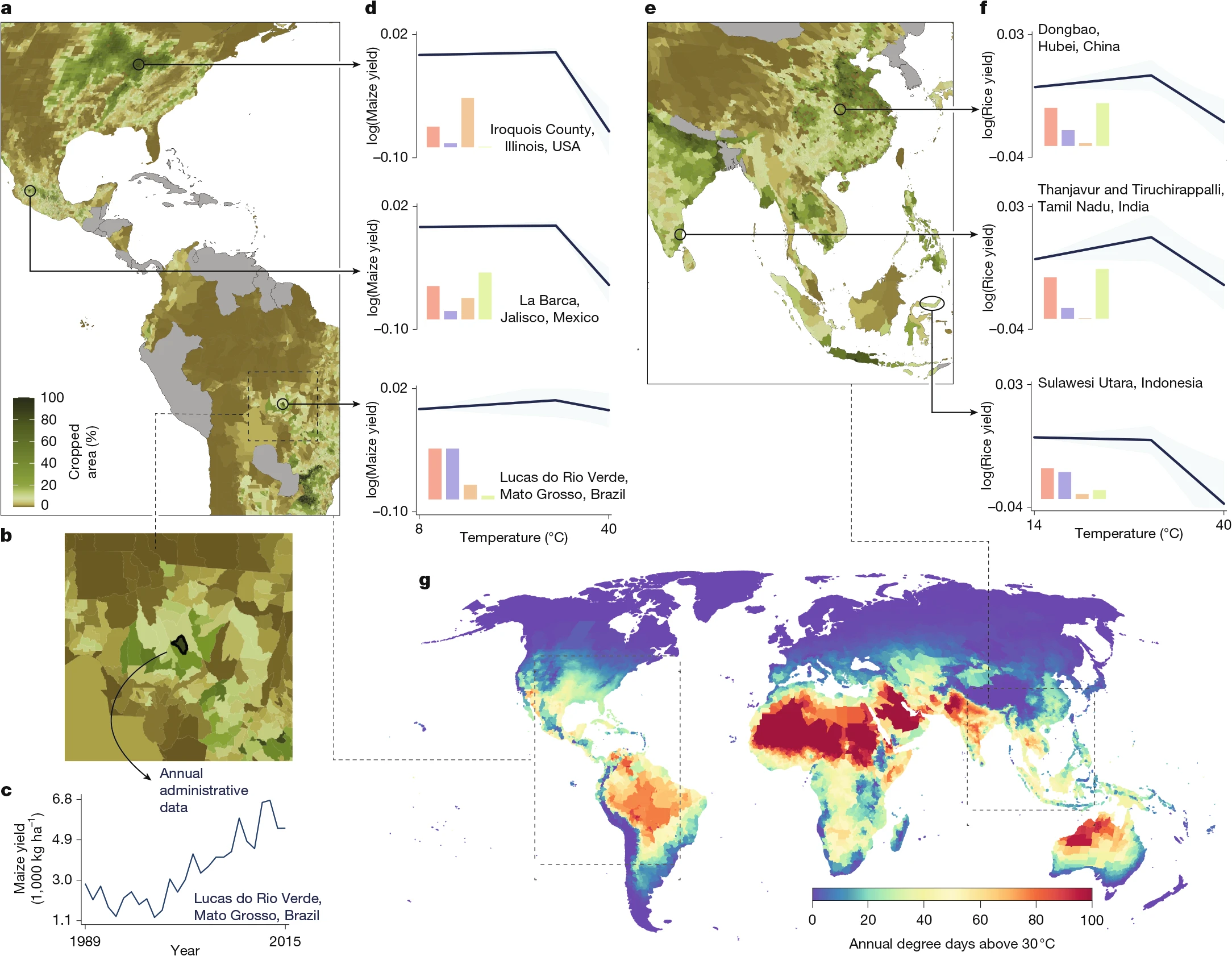


This study uses longitudinal data on six major staple crops across 12,658 regions—covering about two-thirds of global crop calories—to empirically estimate adaptation effects. We find that global production declines by approximately 5.5 × 10¹⁴ kcal per year for each 1°C increase in global mean surface temperature (equivalent to 120 kcal per person per day, or 4.4% of recommended daily intake; P < 0.001).

Projections suggest that adaptation combined with income growth could offset 23% of potential losses by 2050 and 34% by 2100 under a moderate emissions pathway, though substantial losses persist for most crops aside from rice. Interestingly, while many studies emphasize disproportionate harm to low-income regions, our results indicate that significant impacts will also occur in current major production zones—‘breadbaskets’ with relatively favorable climates that have not yet required extensive adaptation. Low-income regions still face significant losses as well. The findings highlight the scale of innovation, land-use change, or additional adaptation measures that may be necessary to secure global food supplies under climate change.

Citation

Hultgren, A., Carleton, T., Delgado, M., Gergel, D. R., Greenstone, M., Houser, T., Hsiang, S., Jina, A., Kopp, R. E., Malevich, S. B., McCusker, K. E., Mayer, T., Nath, I., Rising, J., Rode, A., & Yuan, J. (2025). Impacts of climate change on global agriculture accounting for adaptation. Nature, 642, 644–652. https://doi.org/10.1038/s41586-025-09085-w:contentReference[oaicite:0]{index=0}


Wednesday, January 29, 2025

Building Climate Resilience: Understanding Awareness and Adaptation in Flood-Prone Communities

This study looks at how people in flood-prone areas of Nueva Ecija, the Philippines, understand and respond to climate change. It explores their awareness, attitudes, risks, and actions to adapt to and reduce the effects of climate change. The study also examines how education, income, and location affect the way people prepare for climate risks (Çıplak, 2022, paywall). Around the world, climate-related disasters are increasing, and poorer areas are often hit the hardest (Fawzy et al., 2020, open access).

To gather information, researchers used surveys, informal interviews, and observations with 900 households. The results show that most people have a moderate understanding of climate change. However, families in rural areas take more action to adapt and protect themselves because they feel more at risk. Based on these findings, the study suggests Project LEARN, a program to teach communities more about climate change and help them become stronger against its effects. This research helps local communities understand climate change better and provides ideas to improve how they adapt and reduce risks in areas most affected by it (Fawzy et al., 2020, open access).

Mangansat, N. J. M. (2025). Project LEARN: Climate change risk management and adaptive strategies for flood-prone communities. Risk Governance and Control: Financial Markets & Institutions, 15(1), 91–99. https://doi.org/10.22495/rgcv15i1p9, open access


Why are rural communities are more likely to take action on climate than are urban ones?

The article explains that rural communities are more likely to take action on climate change adaptation and mitigation than urban ones due to several key factors:

  1. Greater Perceived Risk and Vulnerability

    • Rural households perceive themselves as more vulnerable to climate risks, particularly regarding health, access to goods and services, and overall well-being.
    • They rely more on natural resources and are more exposed to climate-induced disasters like floods, making them feel a stronger need to adapt.
  2. Stronger Engagement in Adaptation and Mitigation Strategies

    • Because of their heightened sense of risk, rural respondents reported more frequent adaptation and mitigation behaviors than urban respondents.
    • Actions such as building flood defenses, conserving energy, and improving household emergency plans were more common in rural areas.
  3. Limited Access to Services and Resources

    • Unlike urban populations, who may have more government or institutional support, rural communities often have fewer safety nets and thus take proactive measures to protect themselves.
    • This self-reliance drives them to implement climate adaptation strategies more consistently.
  4. Economic and Occupational Differences

    • Rural communities depend more on agriculture, which is highly sensitive to climate variability (e.g., floods, droughts, erratic weather).
    • The direct impact on their livelihoods makes them more aware of climate risks and more motivated to take action compared to urban dwellers, whose jobs may be less affected.
  5. Household and Socio-Demographic Influences

    • Larger households in rural areas tend to engage more frequently in climate adaptation and mitigation efforts.
    • Education and income levels also play a role—households with lower income and education often perceive higher risks and act accordingly.

In short, rural communities take more climate action because they feel more vulnerable, have fewer external resources, and depend on climate-sensitive livelihoods like farming. Their higher perceived risks and direct exposure to climate change impacts drive more frequent adaptation and mitigation responses compared to urban communities.

Is education level is a negative indicator for taking climate action?

Education level is not a negative indicator for taking climate action, but its relationship with climate adaptation and mitigation is complex. The article suggests that higher education is correlated with greater climate awareness, but not necessarily with higher adaptation and mitigation action. Here’s why:

Key Findings on Education and Climate Action:

  1. Education Increases Awareness but Doesn't Always Lead to Action

    • The study found that higher educational attainment strongly influences climate change perceptions—people with more education tend to have a better understanding of climate change concepts (e.g., causes, impacts, and risks).
    • However, this doesn’t always translate into more frequent adaptation or mitigation behaviors.
  2. Rural Communities with Lower Education Take More Climate Action

    • Rural respondents, who generally have lower education levels, tend to perceive higher climate risks and engage more actively in adaptation and mitigation.
    • This is likely because they experience more direct climate impacts (e.g., crop losses, floods, health risks) and have fewer external safety nets, making adaptation a necessity rather than a choice.
  3. Urban Communities with Higher Education Show Less Urgency in Adaptation

    • Urban respondents, who generally have higher levels of education, perceive lower risks and engage less frequently in adaptation and mitigation strategies.
    • This could be because they rely more on government support, infrastructure, or services, reducing the perceived need for individual action.
  4. Income Plays a Role Alongside Education

    • Higher-income individuals (who often have more education) may have more resources but may not feel as vulnerable, leading to lower adaptation effort compared to lower-income households that must take action to survive.
    • Economic stability allows for passive adaptation (e.g., moving to safer areas, relying on technology), while lower-income households must actively adapt (e.g., building flood barriers, altering agricultural practices).

Overall, education helps people understand climate change, but does not always lead to more climate action—especially if they do not perceive immediate risks. Rural communities with lower education levels take more action because they feel more exposed and lack alternative support systems. However, this doesn’t mean education is a negative factor—rather, it highlights that perceived vulnerability is a stronger driver of climate action than education alone.